


This is Behavioural Governance
Behavioural governance explains what you are experiencing in the room — when governance looks right on paper but feels off in practice.
It is the discipline of understanding how human behaviour, power and decision-making interact within governance systems.
It brings together:
governance frameworks
organisational culture
leadership mindsets
Not as separate concepts — but as forces shaping what actually happens when decisions are made.
Because governance doesn’t operate in theory.
It operates through people.
Through how authority is exercised
How influence is applied
And how decisions are ultimately made
What is Behavioural Governance?
Behavioural governance explains what you are experiencing in the room — when governance looks right on paper, but feels off in practice.
It is the discipline of understanding how human behaviour, power and decision-making interact within governance systems.
-
It brings together:
-
governance frameworks
-
organisational culture
-
leadership mindsets
-
Not as separate concepts — but as forces shaping what actually happens when decisions are made.
Because governance doesn’t operate in theory.
It operates through people.
Through how authority is exercised
How influence is applied
And how decisions are ultimately made
The Behavioural Governance Institute advances the discipline of Behavioural Governance through research, education and practice.
Behavioural Governance recognises that governance effectiveness is shaped by more than structures, policies and compliance. It is also influenced by the behavioural conditions within which governance operates, including how trust is built, authority is exercised, challenge is encouraged, decisions are made and accountability is experienced.
The Institute exists to advance understanding of these human dynamics and to support their practical application across boards, executive teams and governance environments. By bringing together research, evidence-informed frameworks and practitioner insights, the Institute seeks to make behavioural governance more visible, measurable and actionable.
Our work includes original research, the Global Behavioural Governance Dynamics™ Assessment, the Annual Behavioural Governance Report, educational programs, publications and thought leadership that contribute to the growing body of knowledge in Behavioural Governance. We are also committed to fostering collaboration between practitioners, researchers and organisations who share an interest in strengthening governance through a deeper understanding of human behaviour and decision-making.
The Behavioural Governance Institute exists to bridge the gap between governance theory and governance practice. By advancing the discipline of Behavioural Governance, we aim to strengthen governance capability, improve decision-making and contribute to more effective leadership and organisational stewardship.


What Shapes the Room?
Every Boardroom is shaped by two forces — what the environment creates, and what people bring into it.
Power, authority and decision dynamics meet individual mindsets, values and presence, shaping how the room actually operates.
You’re not separate from it. You influence what happens — even in the moments you say nothing.
HOW IT PLAYS OUT
Behavioural governance shows up differently depending on the environment.

In public policy and regulatory systems
It focuses on how systems are designed to influence behaviour at scale.
Drawing on behavioural economics and psychology, this work shapes:
decision environments
incentives
social norms
This body of work has been developed and advanced by leading academics and researchers in governance and public policy.

In Boardrooms and leadership environments
This is where you feel it.
Not as a concept.
As a lived experience.
It shows up in:
How authority is exercised
Whether challenge is invited — or avoided
How decisions are shaped before, during and after the meeting
Whether accountability is clear — or quietly diffused
This is where governance either holds under pressure.
Or breaks down without anyone naming it.

Are you ready to measure the behavioural dynamics in your decision-making environment?
Most people can feel when something isn’t right in the room. Very few can see it clearly.
The Behavioural Governance Dynamics™ Assessment surfaces what’s actually shaping decision-making in your environment — beyond structure, beyond intention, and beyond what’s written on paper.
Global
Behavioural Governance Dynamics™ Assessment
(Complimentary)
You know when something isn’t right in the room.
This will show you what it is. A targeted entry point into the Behavioural Governance Dynamics™ Assessment, designed to surface the behavioural patterns shaping decision-making, authority and accountability in your environment — before they become embedded or escalate.
This assessment is always available and contributes to an aggregated global view of behavioural governance dynamics, released each July.
Initial
Behavioural Governance Dynamics™ Assessment
When experiences differ across the room, alignment becomes harder than it should be.
This is a right-sized diagnostic designed to compare how behavioural governance is experienced across roles, creating visibility into perception gaps, early behavioural risk signals, and where focus should be directed before deeper intervention.
It is often the point where what has been felt individually becomes visible collectively.
Full
Behavioural Governance Dynamics™ Assessment
When the dynamics are systemic, they need to be seen at a system level.
This is a comprehensive behavioural governance assessment across the full Board and leadership environment, designed to surface the patterns shaping decision-making, authority, culture and risk.
It provides a clear view of how governance is functioning in practice, alongside a structured pathway to strengthen alignment, accountability and decision quality.
About
My name is Lisa Coletta
I work with Boards, Chairs, CEOs and governance professionals to strengthen how governance operates in practice — not just on paper. With over two decades of experience supporting Boards, my work bridges governance frameworks with the behavioural dynamics that shape decision-making, trust and alignment in the room — because governance doesn’t fail in design, it fails in how it’s experienced.


THE BOOK
Behavioural Governance — the Human Dynamics Behind Boardroom Decision-Making is the practitioner’s guide to behavioural governance in Boardrooms.
It gives Boards, Chairs, CEOs and governance professionals a practical way to understand the dynamics shaping decisions before, during and after the meeting.
It brings language and structure to the moments that often remain unnamed:
-
power
-
silence
-
influence
-
trust
-
challenge
-
accountability
This is where the discipline is set out clearly — for those who want to understand not only what governance says on paper, but how it is experienced in the room.
Behavioural Governance Master Classes
A series of complimentary LinkedIn masterclasses sharing thought leadership on how behavioural governance is experienced in the room. Each session focuses on a different moment, role or dynamic — offering a practical lens into what shapes decisions before, during and after the meeting.
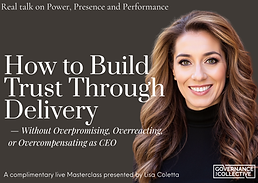
How to Build Trust Through Delivery
— Without Overpromising, Overreacting, or Overcompensating as CEO
For CEOs who are delivering — but can feel trust is still being quietly assessed in the room.
This session focuses on what Boards read under pressure, and how trust is built through behaviour — not performance.
How to Chair a Board Without Wearing a Crown
— Leading with Clean Power, Not Control
For Chairs who can feel the room tighten, fragment, or drift — even when the process looks sound.
This session explores how your presence shapes the dynamic, and whether the Board aligns or works around you.

How to Stand in Your Power as a Governance Steward
— Without Playing Servant, Playing Safe, or Playing Small
For governance professionals who feel the tension first — and carry more than the role formally holds.
This session focuses on stepping into clean influence, setting boundaries, and no longer absorbing what should be addressed.

How to Keep Power Clean
— The Chair–CEO Interface That Builds Trust, Not Power Plays
For leaders who can feel when power shifts — in subtle dominance, silence, or overreach.
This session focuses on recognising those moments early and holding authority cleanly, without distortion, control or withdrawal.

Behavioural Governance 101
A practitioner’s introduction to the behavioural dynamics shaping decision-making in Boardrooms
If you’ve recently completed the Behavioural Governance Dynamics™ Assessment — you’ve already seen how these patterns show up in your environment.This session is where you learn how to work with them.
